Auto Hinges Size Chart: Crank Type, Opening Degree, Drill Bit and Cup Distance
- Category
- Cabinet Hinges
- Published
- Reading time
- 8 min read
Overview
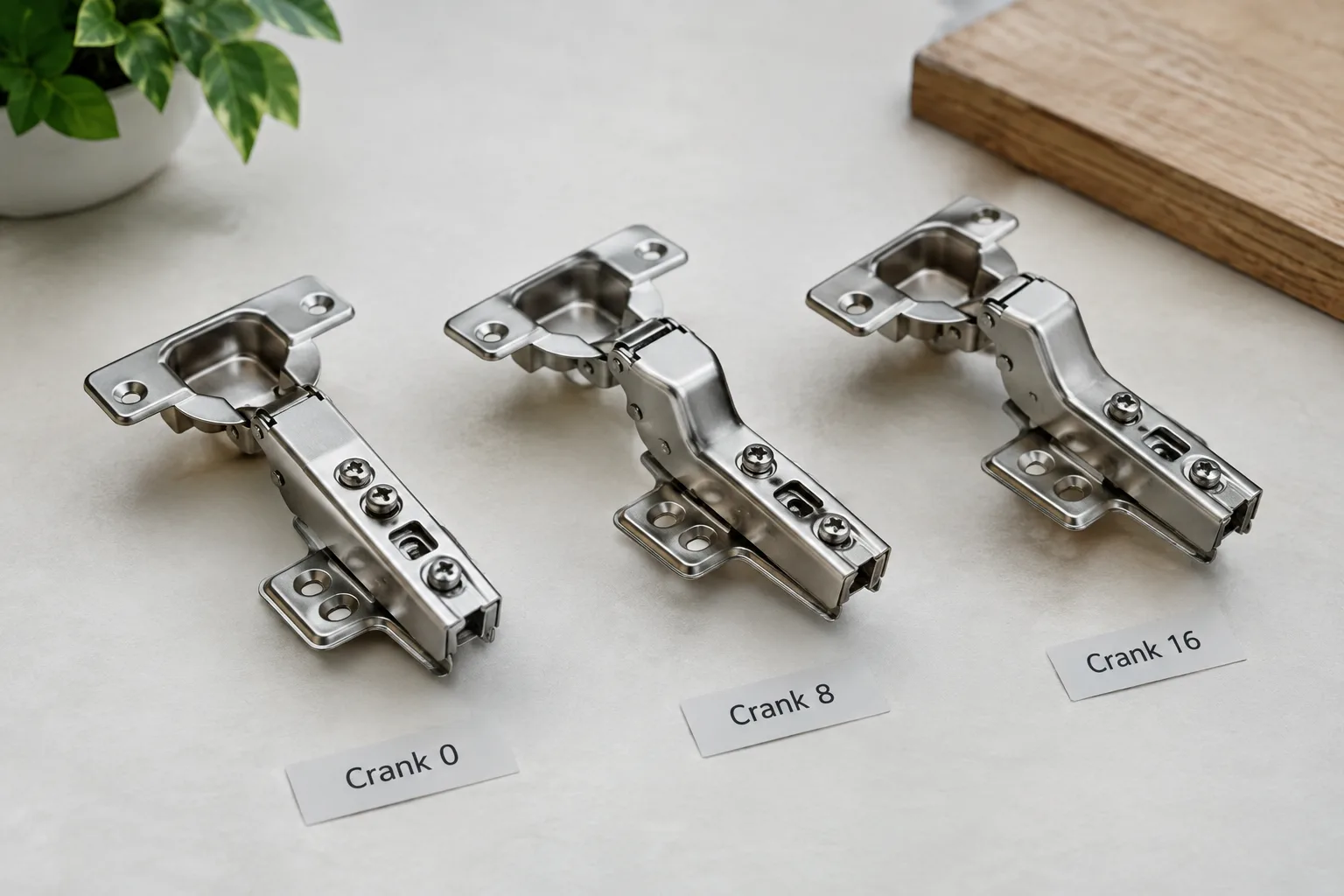
An auto hinges size chart comes down to four numbers: the crank (0, 8 or 16), the opening degree, the drill bit size for the cup hole and the cup distance from the door edge. Crank 0 suits full overlay doors, crank 8 suits half overlay doors that share a side panel, and crank 16 suits inset doors that sit inside the carcass. Most auto hinges use a 35 mm cup, bored with a 35 mm bit and set a few millimetres in from the door edge.
Get these four right and the door closes flush, the gaps stay even and the shutter does not rub against its neighbour. Get one wrong and no amount of screw adjustment will fully fix it. This guide walks modular kitchen makers, carpenters and fabricators through each specification in simple terms.
Auto hinges size chart at a glance
Use this quick reference when planning a kitchen or wardrobe. Always confirm the exact figures against the product specifications of the hinge you are buying, because dimensions vary between models.
- Crank 0 (straight arm): full overlay. The door covers the front edge of the side panel.
- Crank 8 (half bend): half overlay. Two doors share one middle panel, each covering part of it.
- Crank 16 (full bend): inset. The door sits inside the cabinet opening, flush with the front of the carcass.
- Cup diameter: 35 mm on most standard concealed hinges.
- Drill bit: 35 mm Forstner or hinge boring bit, matched to the cup.
- Cup distance: commonly around 3 to 6 mm from the door edge to the edge of the cup hole. A larger distance reduces overlay.
- Opening degree: a standard opening for everyday cabinets, with wide-angle versions made for corner units and pull-out access where the range offers them.
Crank type: 0, 8 and 16 explained
The crank is the bend in the hinge arm. It decides where the door sits in relation to the side panel. In Indian hardware shops, the terms 0, 8 and 16 crank are the everyday way to ask for each type.
Crank 0 for full overlay doors
A crank 0 hinge has a straight arm. The door closes over the front edge of the side panel and covers it almost completely. This is the most common choice for end cabinets, single wall units and wardrobe shutters where each side panel carries only one door.
Crank 8 for half overlay doors
Auto hinges 8 crank have a slight bend in the arm. They are used where two doors are hinged on the same middle partition, which happens often in long base cabinets and tall units. Each door covers roughly half the panel thickness, leaving a small gap between the two shutters so they do not clash.
Crank 16 for inset doors
A crank 16 hinge has a deep bend, so the door sits inside the cabinet opening. Inset doors give a clean, flat front, but they need accurate carcass construction because any unevenness in the opening shows immediately as uneven gaps.
A simple way to choose:
- One door on the side panel, door in front: crank 0.
- Two doors on one panel, both in front: crank 8.
- Door inside the opening: crank 16.
Opening degree: how far the door swings
Auto hinges degree refers to how wide the door opens from the closed position. Standard hinges are designed for regular base and wall cabinets, where a normal opening gives comfortable access to shelves.
Wide-angle hinges open further and are useful for corner cabinets, units with internal drawers or pull-out baskets, and anywhere the door must swing fully clear of the opening. Before specifying a wide-angle hinge, check that the cabinet has space for the door to swing without hitting a wall, appliance or adjacent tall unit. Also check whether the specific model you plan to use is offered in a wide-angle version in the catalogue.
Drill bit size and cup depth
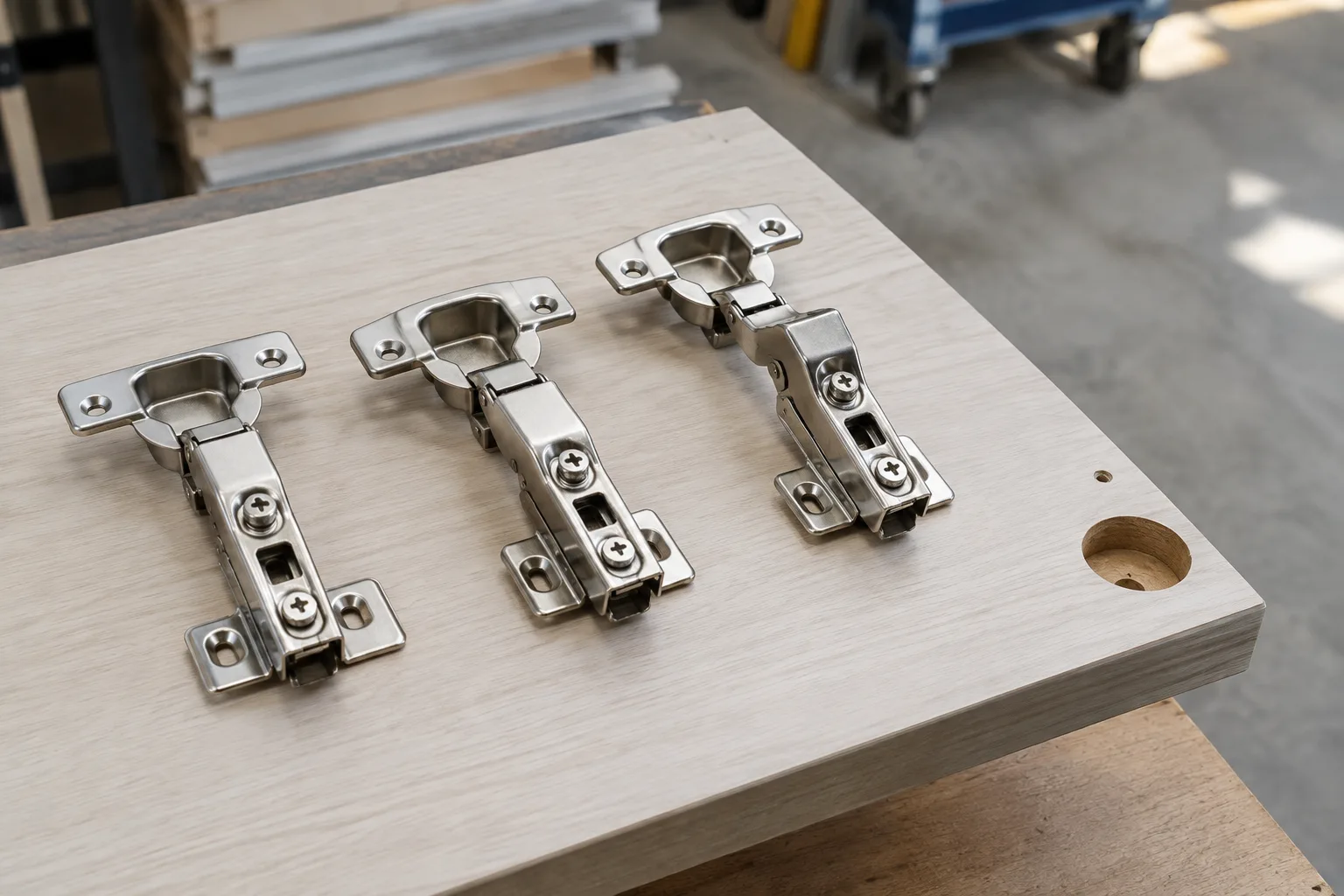
The 35 mm cup is the size most hinge manufacturers use for standard concealed cabinet hinges, which is why the 35 mm Forstner bit has become a basic tool in Indian furniture workshops. For auto hinges drill bit selection, match the bit to the cup diameter stated in the product specifications. A smaller bit makes the cup tight and can crack the board edge; a larger one leaves the cup loose.
Cup depth matters as much as diameter. Most cups need a hole roughly 11 to 13 mm deep, depending on the hinge. On 16 mm or 18 mm boards, which are common in modular kitchens, this leaves enough material behind the cup. Use a depth stop or a drill stand so you never break through the face of the shutter.
- Mark hole centres from the top and bottom of the door first, then set the cup distance.
- Keep the drill square to the board so the cup sits flat.
- Pre-drill small pilot holes for the cup screws to avoid splitting particle board or MDF.
Cup distance and overlay
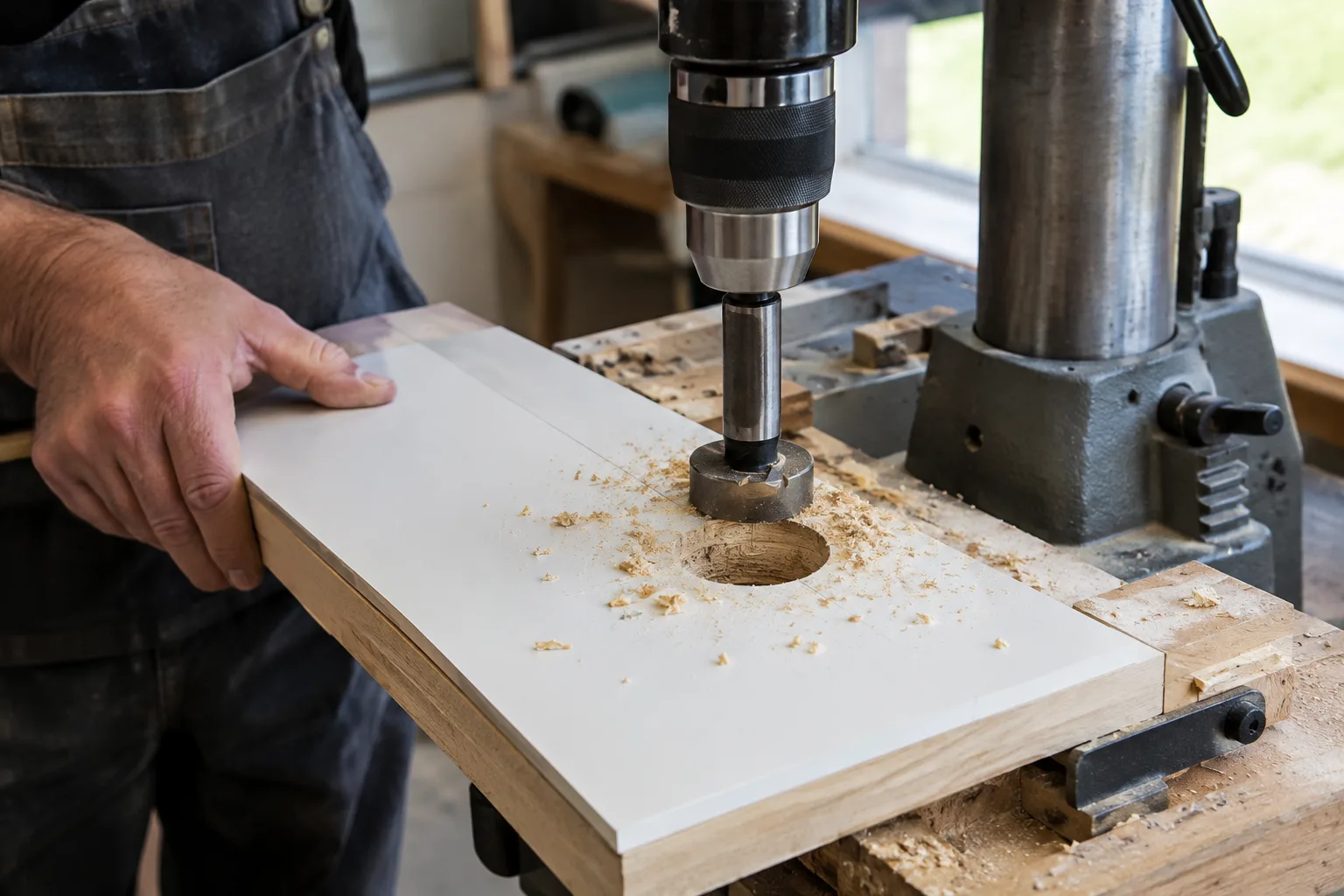
Cup distance is the gap between the door edge and the edge of the 35 mm cup hole. It works together with the crank and the mounting plate to set the final overlay. Increase the cup distance and the door covers less of the side panel. Reduce it and the door covers more.
This is the number most often overlooked in auto hinges fitting. Two carpenters using the same crank 0 hinge can end up with different overlays simply because one drilled 3 mm in and the other 5 mm in. On a kitchen with many shutters, keep one cup distance throughout so the gaps line up across every unit.
Many auto hinges also offer side, height and depth adjustment screws. These are for fine-tuning after installation, not for correcting a wrong crank or a badly placed cup. Treat them as a final step.
Regular or soft close: choosing the mechanism
Once crank, degree and cup distance are fixed, choose the closing action. A regular auto hinge pulls the door shut on its own spring. An auto hinges soft close model adds a damper that slows the door in the last part of its swing, so it closes quietly without banging. If you want to understand how the damping works and where it is worth using, read our guide to soft-close cabinet hinges.
LUMA Hardware offers MS regular, MS soft close and SS soft close options in its auto hinges range. Mild steel MS regular auto hinges are a practical choice for wardrobes and dry storage units, while MS soft close auto hinges suit everyday kitchen cabinets where quiet closing is wanted. Stainless steel is generally preferred near the sink and other damp areas because it handles moisture better than mild steel. Check the material and finish in the product specifications before final selection.
Auto hinges fitting checklist for workshops
Before a kitchen leaves the workshop or goes up on site, run through these checks:
- Confirm the crank for every door: 0, 8 or 16, based on how the door meets the panel.
- Check board thickness against the required cup depth.
- Use a 35 mm bit, or the size given in the hinge specifications.
- Keep one cup distance across all shutters in the kitchen.
- Add hinges as door height and weight increase; tall pantry doors usually need more than two.
- Choose the opening degree to suit corner units and internal fittings.
- Select regular or soft close, and MS or SS, based on location and use.
- Fine-tune with the adjustment screws only after mounting.
Sourcing auto hinges in Pune
LUMA is building relationships with hardware retailers across Pune, from Handewadi and Kondhwa to Baner, Wakad and Bhosari MIDC, so carpenters and kitchen makers can find the range at their local counter. Explore the LUMA catalogue to compare available configurations and product dimensions, or ask your nearby hardware store about LUMA availability.
If you run a hardware store and want to carry the range, or you need help matching a hinge to a specific cabinet design, contact the LUMA team for retailer partnership enquiries and product selection guidance.
Frequently asked questions
Which crank auto hinge should I use for a modular kitchen?
It depends on how each door meets the side panel. Use crank 0 when one door covers a side panel, crank 8 when two doors share a middle partition, and crank 16 when the door sits inside the cabinet opening. Most kitchens use a mix of crank 0 and crank 8.
What drill bit size is used for auto hinges?
Most standard auto hinges have a 35 mm cup, so a 35 mm Forstner or hinge boring bit is used. Always confirm the cup diameter in the product specifications of the hinge you are fitting. Use a depth stop so the bit does not break through the face of the door.
What is cup distance on a hinge?
Cup distance is the gap between the door edge and the edge of the cup hole, commonly a few millimetres. It controls how much of the side panel the door covers. A larger cup distance gives less overlay, a smaller one gives more.
Is soft close worth it for kitchen cabinets?
For kitchens used many times a day, soft close hinges prevent doors from banging and reduce knocks on the cabinet. Regular hinges still work well for wardrobes and storage units used less often. The choice comes down to use, budget and preference.
Where can I buy LUMA auto hinges in Pune?
LUMA is building its retailer network across Pune and supplies through hardware stores. Ask your local hardware retailer about LUMA availability, or contact LUMA directly to find a retailer near you.