Drywall Screw Sizes Explained: How to Pick Length, Gauge and Thread
- Category
- Screws & Fasteners
- Published
- Reading time
- 7 min read
Overview
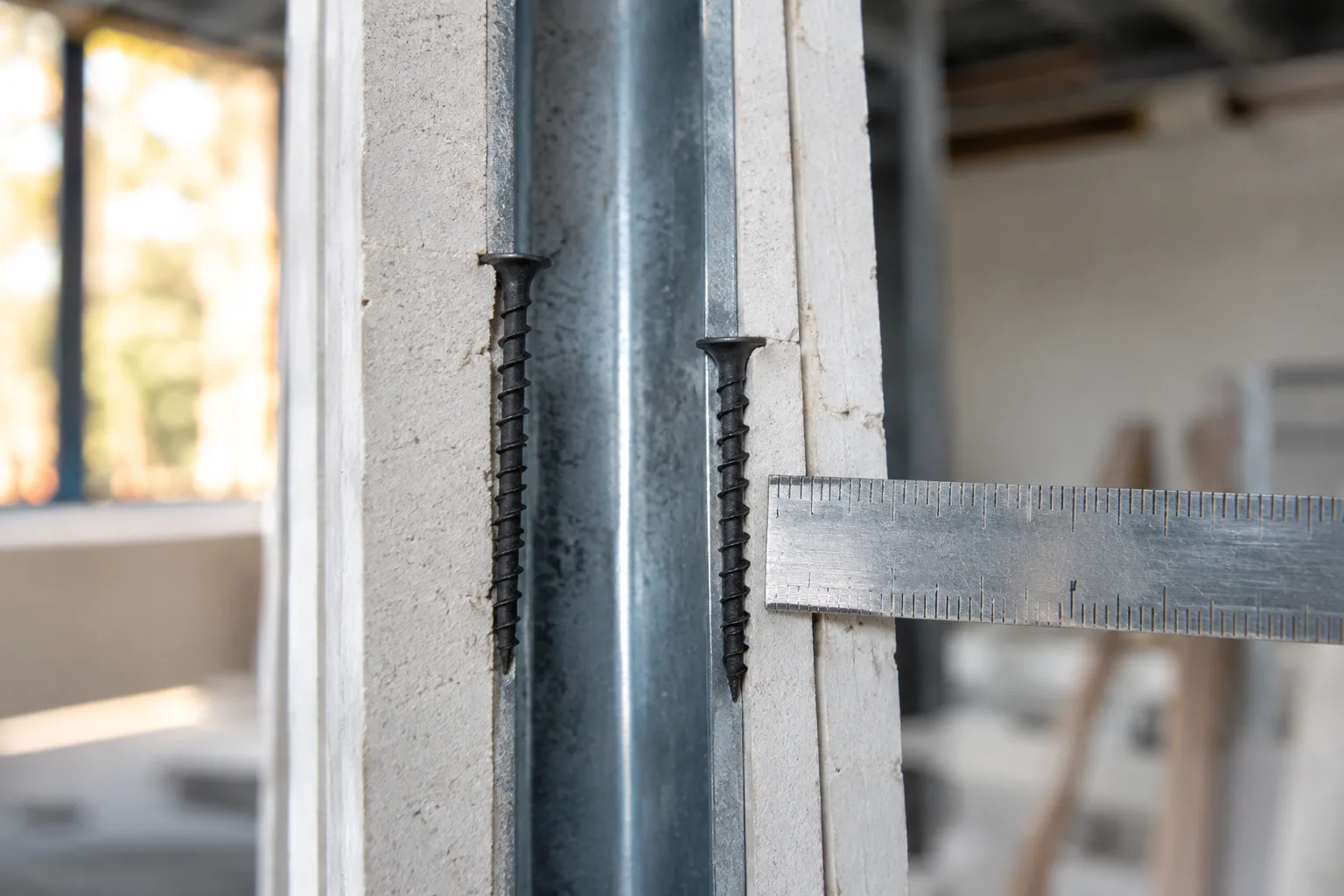
To choose drywall screw sizes, add the total board thickness to the penetration you need into the framing: at least 10 mm into a light-gauge steel stud, and at least 16 mm into timber. Use fine thread for steel and coarse thread for timber, and a 3.5 mm (#6) shank for most single and double-layer board work. For one layer of 12.5 mm board on metal channel, that works out to a 25 mm fine thread screw. Two layers need 35 mm.
The rest of this guide breaks that down by board thickness, stud type and finish, so you can match the screw to the job before you place a bulk order.
Drywall screw sizes: the length rule
Length is the first number on any drywall screw code (or the second, depending on how the supplier writes it, so check whether the code reads diameter x length or the other way round). The rule is simple:
Screw length = total board thickness + minimum penetration into the stud.
The penetration figures come from long-standing gypsum board installation guidance, including the Gypsum Association's GA-216 application specification: about 10 mm (3/8 inch) into steel framing and about 16 mm (5/8 inch) into timber. Go much shorter and the board can pull off the screw head under load or vibration. Go much longer and you waste screw, slow the driver and, on timber, risk hitting services behind the stud.
Common board thicknesses in the Indian market are 9.5 mm, 12.5 mm and 15 mm. Working the rule through:
- 9.5 mm board, steel stud: 9.5 + 10 = 19.5 mm, so a 25 mm screw.
- 12.5 mm board, steel stud: 12.5 + 10 = 22.5 mm, so a 25 mm screw.
- 15 mm board, steel stud: 15 + 10 = 25 mm, so a 32 mm or 35 mm screw.
- 2 x 12.5 mm board, steel stud: 25 + 10 = 35 mm, so a 35 mm screw for the outer layer.
- 12.5 mm board, timber batten: 12.5 + 16 = 28.5 mm, so a 32 mm or 35 mm screw.
- 2 x 15 mm board, steel stud: 30 + 10 = 40 mm, so a 41 mm to 45 mm screw.
Always round up to the next size you stock, never down. On double-layer partitions, the inner layer is usually fixed with the shorter screw and the outer layer with the longer one, so contractors often order two lengths for the same job.
Gauge: 3.5 mm vs 4.2 mm shank
Drywall screws are sold in metric diameters (3.5 mm, 3.9 mm, 4.2 mm and so on) and sometimes in imperial gauge (#6, #7, #8). The two you will see most often:
- 3.5 mm (#6): the standard for single and double-layer board on light-gauge steel channel or timber. Drives fast, holds well in board up to two layers.
- 3.9 mm to 4.2 mm (#7 to #8): used for longer screws (roughly 50 mm and above), triple-layer board, fixing into heavier timber, or where the screw has to carry more than the board itself, such as light fixtures fixed through board into framing.
A thicker shank is not automatically better. In steel channel, an oversized screw can strip the thin metal rather than tap a clean thread. Match the gauge to the length and the substrate, not to a general feeling that heavier is stronger.
Fine thread vs coarse thread drywall screws
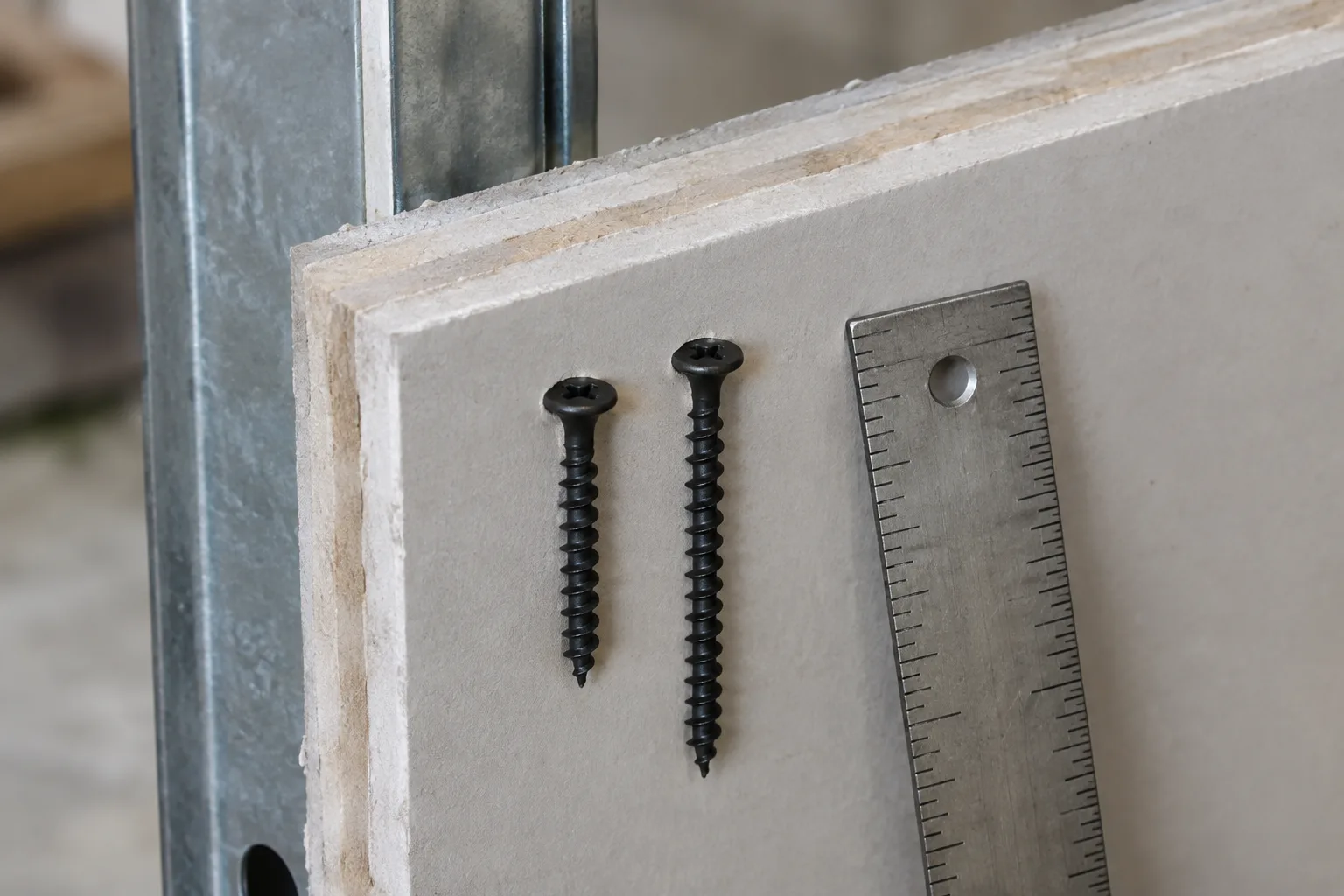
This is where most wrong orders happen. The choice depends entirely on what the board is being fixed to.
Fine thread for steel studs
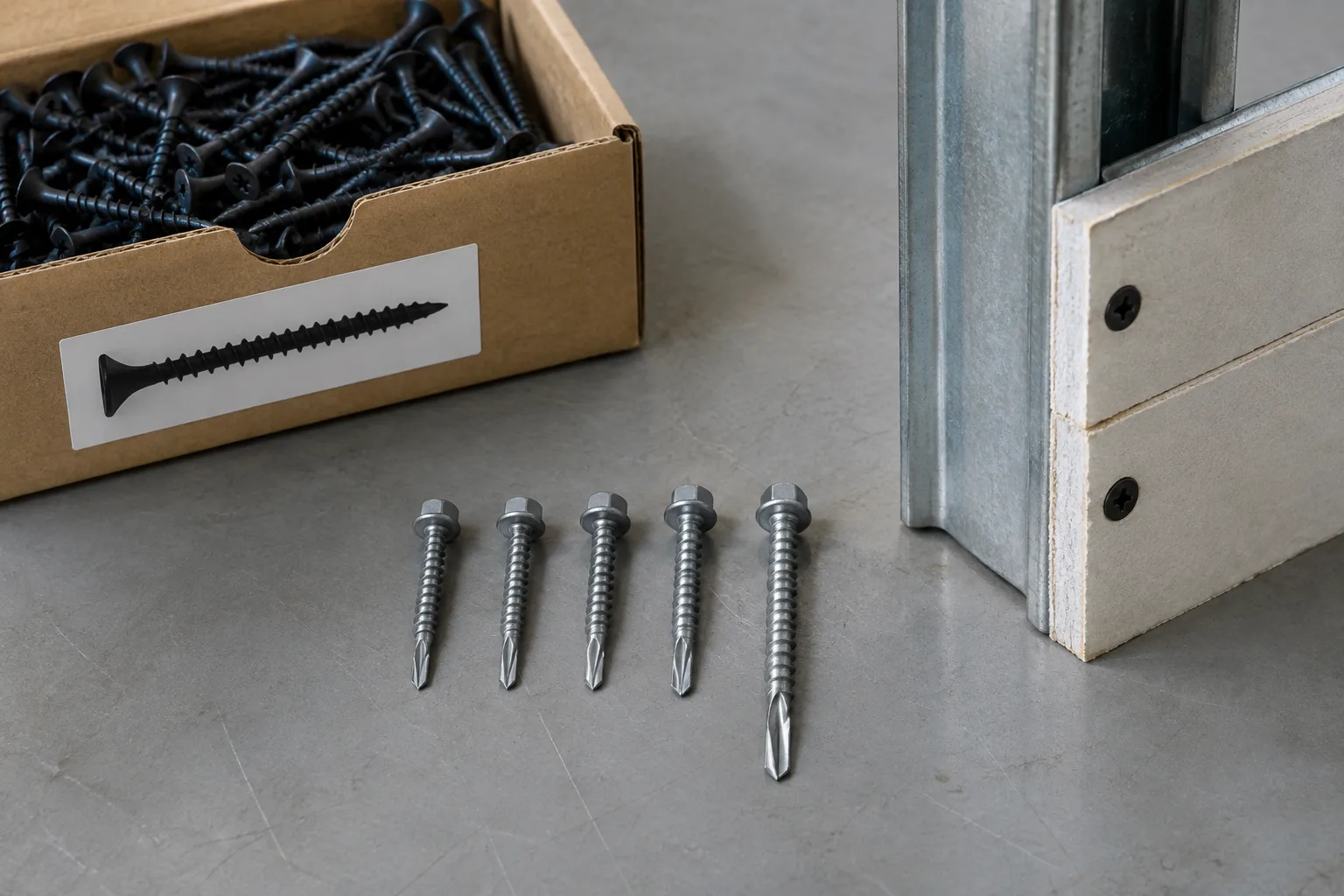
ASTM C1002, the American specification most drywall screw manufacturers in India and abroad reference, defines Type S screws: fine thread with a sharp point, for steel studs. ASTM C1002 covers steel framing up to 0.84 mm (0.033 inch) thick, which takes in the light-gauge channels used for most partitions and false ceilings. Fine threads give more thread engagement in thin metal and are less likely to spin out.
Coarse thread for timber
The same standard defines Type W: coarse thread, for timber framing. Wider-spaced threads bite into wood fibre and pull the board tight. Used in steel, a coarse thread tends to wander on the surface and strip.
Drill point for heavier steel
Once the steel is thicker than about 0.84 mm, a sharp point struggles to pierce it. ASTM C954 covers screws for steel from 0.84 mm to 2.84 mm (0.033 to 0.112 inch), and these usually carry a drill point. If your framing is heavier-section steel, specify drill-point drywall screws or step up to self-drilling screws. You can see both ranges on our screws and fasteners page.
Black drywall screws: what the finish does
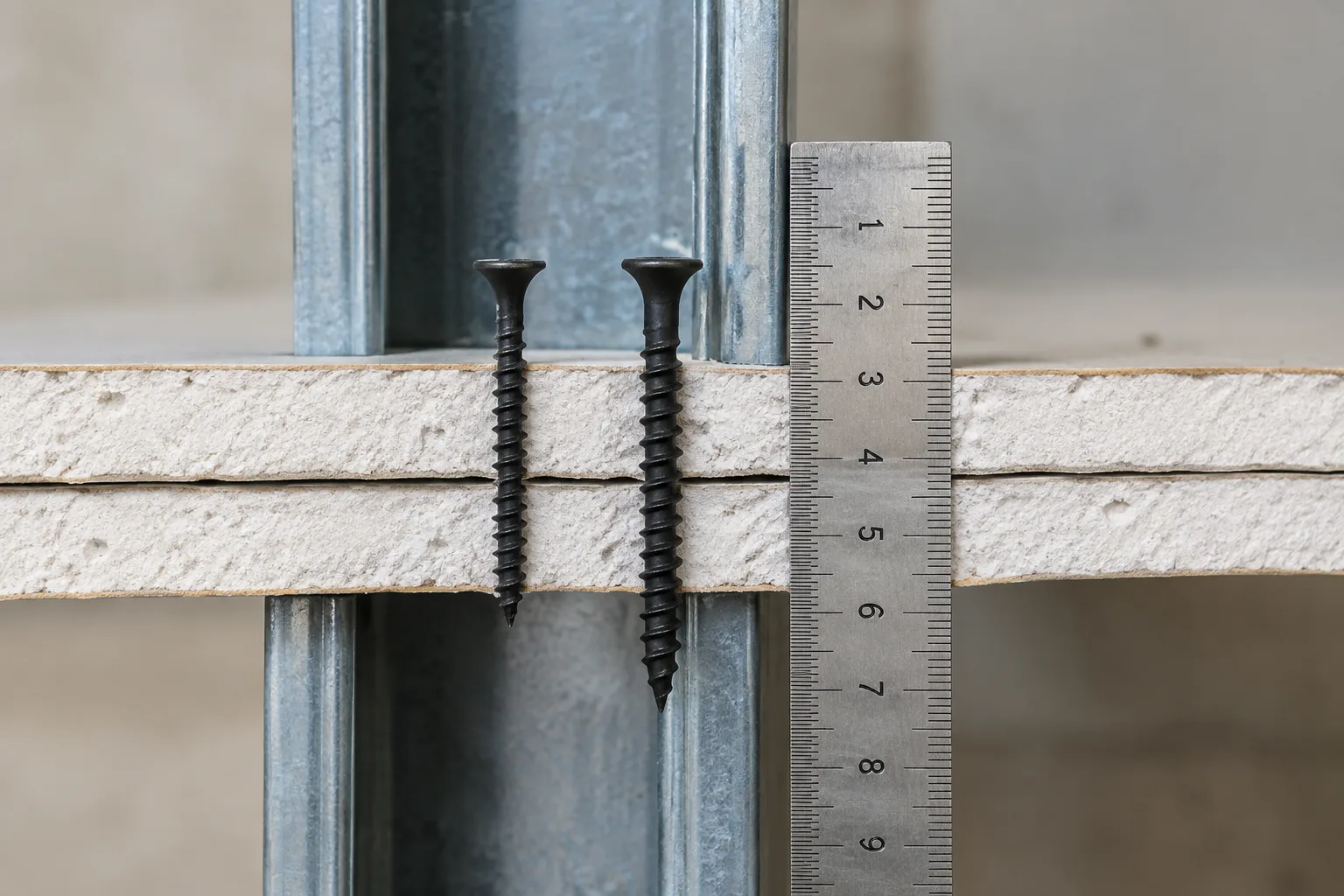
Black drywall screws carry a black phosphate coating. It is the standard finish on drywall screws for a few practical reasons:
- It gives light corrosion resistance for interior, dry conditions.
- Joint compound and paint key onto it well, so heads are easier to cover.
- The dark head is easy to spot when checking that every fixing is set.
Phosphate is not a substitute for zinc plating or stainless steel. For bathrooms with moisture-resistant board, external soffits or high-humidity areas, specify a zinc-plated or other corrosion-resistant screw. For standard interior partitions and ceilings across Pune, black drywall screws are the default.
The bugle head shape matters too. It is designed to sit just below the board surface without tearing the paper face. A flat or countersunk head driven into board will cut the paper and lose holding power.
Quick reference by job
- Single-layer false ceiling, 12.5 mm board, GI channel: 3.5 x 25 mm, fine thread, black phosphate.
- Double-layer partition, 2 x 12.5 mm board, steel stud: 3.5 x 25 mm (inner) and 3.5 x 35 mm (outer), fine thread.
- Board on timber battens, 12.5 mm: 3.5 x 32 mm or 3.5 x 35 mm, coarse thread.
- 15 mm fire or sound board, steel stud: 3.5 x 32 mm or 3.5 x 35 mm, fine thread; longer for double layer.
- Heavier steel section framing: drill-point drywall screw or self-drilling screw, sized by the same length rule.
For screw selection on furniture and joinery rather than board, see our guide on choosing screws for stronger furniture.
Common sizing mistakes
- Ordering one length for a double-layer job. The outer layer needs the longer screw.
- Using coarse thread in steel channel. It spins and strips, especially in thin GI sections.
- Overdriving. A screw driven through the paper face has lost most of its hold. Set the clutch so the head sits just below the surface.
- Reading the code backwards. 3.5 x 25 and 25 x 3.5 are the same screw, but confirm the format before ordering 10,000 of them.
Buying drywall screws direct in Pune
LUMA is a direct-to-retail brand based at Handewadi Trade Market. We supply retailers and contractors with no distributor in between, which gives you better pricing control and higher retailer margins than buying through a distribution chain. More on how that works is on our about page.
Our screw catalogue publishes 127 sizes and codes across 7 ranges, covering self-drilling, drywall, hex head, truss head and pan head screws, so you can match codes to your job sheet before you call. If you are comparing drywall screw suppliers, ask for the full size list, not just the fast movers.
Send us the specification and quantities you need on WhatsApp or phone (+91 98674 35326), Monday to Saturday, and you will get a same-day response from the people who hold the stock. Bulk and dealer enquiries, and questions about the retail partner program, go through the same line. Use Request Pricing to get a quote for specific sizes.
Frequently asked questions
What size drywall screw do I need for 12.5 mm board on metal channel?
For a single layer of 12.5 mm board on light-gauge steel channel, use a 3.5 x 25 mm fine thread drywall screw. That gives the roughly 10 mm penetration into steel recommended in gypsum board installation guidance. For two layers, use 35 mm on the outer layer.
Can I use fine thread drywall screws in timber?
You can, but coarse thread is the better choice. ASTM C1002 specifies Type W coarse thread screws for timber because the wider threads grip wood fibre and pull the board tight. Fine threads are designed for thin steel and hold less well in wood.
Are black drywall screws suitable for bathrooms?
Black phosphate drywall screws are intended for interior, dry conditions. For bathrooms, wet areas or external work, specify a zinc-plated or other corrosion-resistant screw alongside moisture-resistant board. Tell us the application when you enquire and we will suggest the right range.
Do you supply drywall screws in bulk to retailers and contractors?
Yes. LUMA supplies retailers, contractors and fabricators direct from Handewadi Trade Market, with no distributor in between. Send the sizes and quantities on WhatsApp or phone (+91 98674 35326), Monday to Saturday, for a same-day response with pricing.
When should I use self-drilling screws instead of drywall screws?
Switch to drill-point drywall screws or self-drilling screws when the steel framing is thicker than about 0.84 mm, the upper limit covered by ASTM C1002. Heavier sections fall under ASTM C954, where a sharp point will not pierce reliably. Both ranges are listed on our screws page.